What are Italy’s new measures against violent protests?
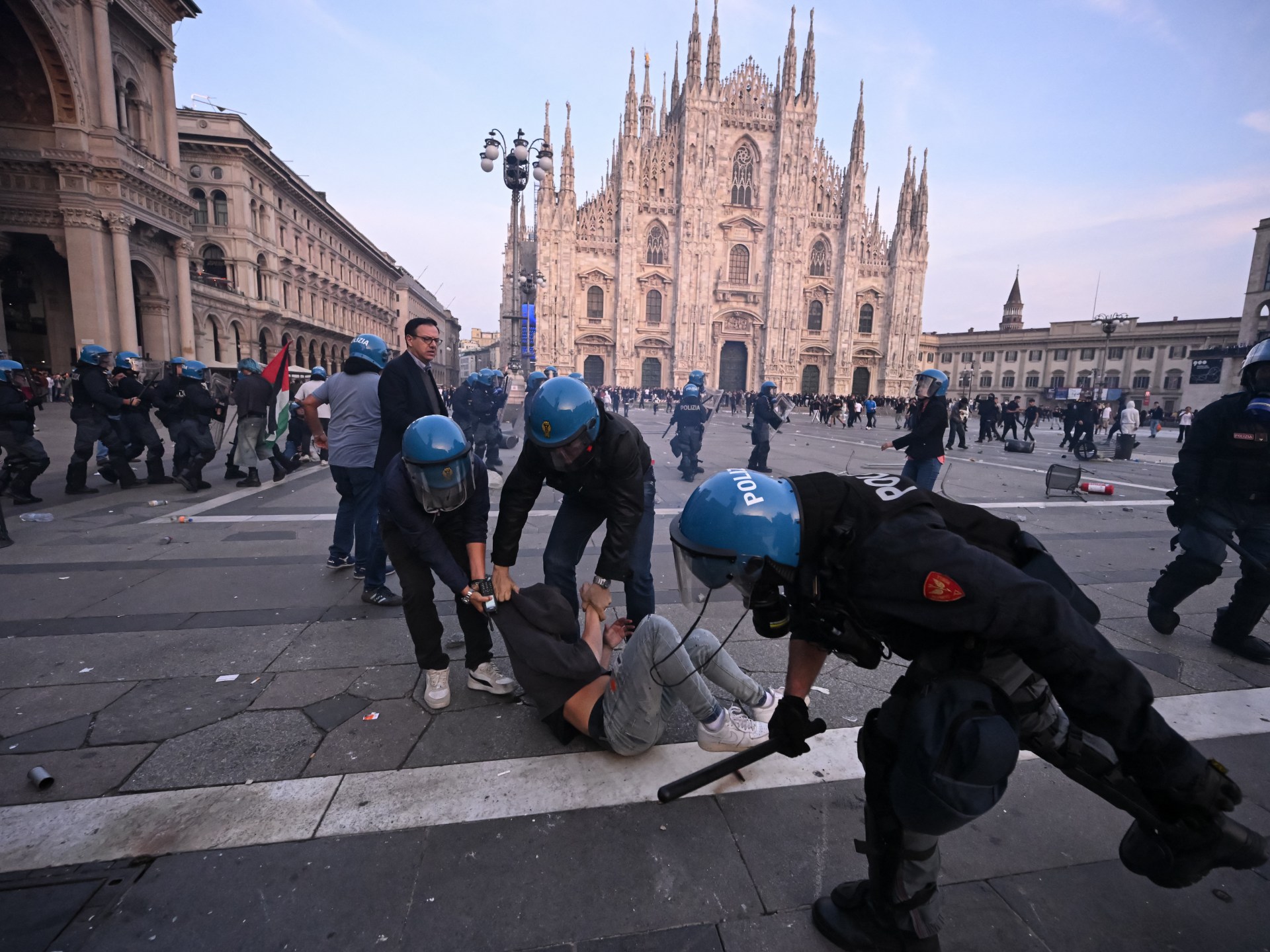
The government has unveiled a new offence of ‘violent participation in public demonstrations’, among other measures. Save Share The right-wing government of Italy’s Prime Minister Giorgia Meloni has approved araft of security measures, including the deployment of 500 troops in the financial capital Milan, to curb youth-led protests that turned chaotic over the weekend. “There is nothing revolutionary about vandalising and stealing. Vandalism and theft are not protest, they are criminality,” Meloni wrote on social media on Tuesday, unveiling the decree. Unrest broke out on Saturday in Milan during a peaceful rally overrising living costsand poor school conditions inspired by similar mobilisations in neighbouring Spain andFrance. Groups of mainly young people looted shops, smashed windows and clashed with the police again on Sunday, with riots also reported in Bologna and Turin. Here’s what we know about the new measures. The Italian cabinet approved sending 500 troops to Milan until the end of the year to maintain security at key sites, step up surveillance of sensitive locations, and enhance monitoring across the area, the Defence Ministry said in a statement. It is unclear what the army will be able to do, given that the cabinet stopped short of granting soldiers additional policing powers following opposition from President Sergio Mattarella. In Italy, the army is responsible for national defence while police carry out investigations and arrest duties. As part of the new legal measures, which take effect immediately, the government has also introduced a new offence of “violent participation in public demonstrations” targeting people gathering in groups of more than five who use potentially harmful objects including stones, sticks and fireworks. The offence is punishable with up to five years in prison and a fine up to 20,000 euros ($22,440). The text of the decree also cites the saying “You break it, you buy it” as grounds for making the parents of minors financially liable for the damage caused by their children. The state can claim damages for any resulting loss against parents’ properties or by deducting public subsidies received by the family. Children and young people aged 14 to 18 will also be subject to administrative detention, even if they have not committed a crime, provided there is evidence they pose a danger, extending powers that previously applied only to adults....