Who owns India’s textile traditions in age of AI-enabled mass production?
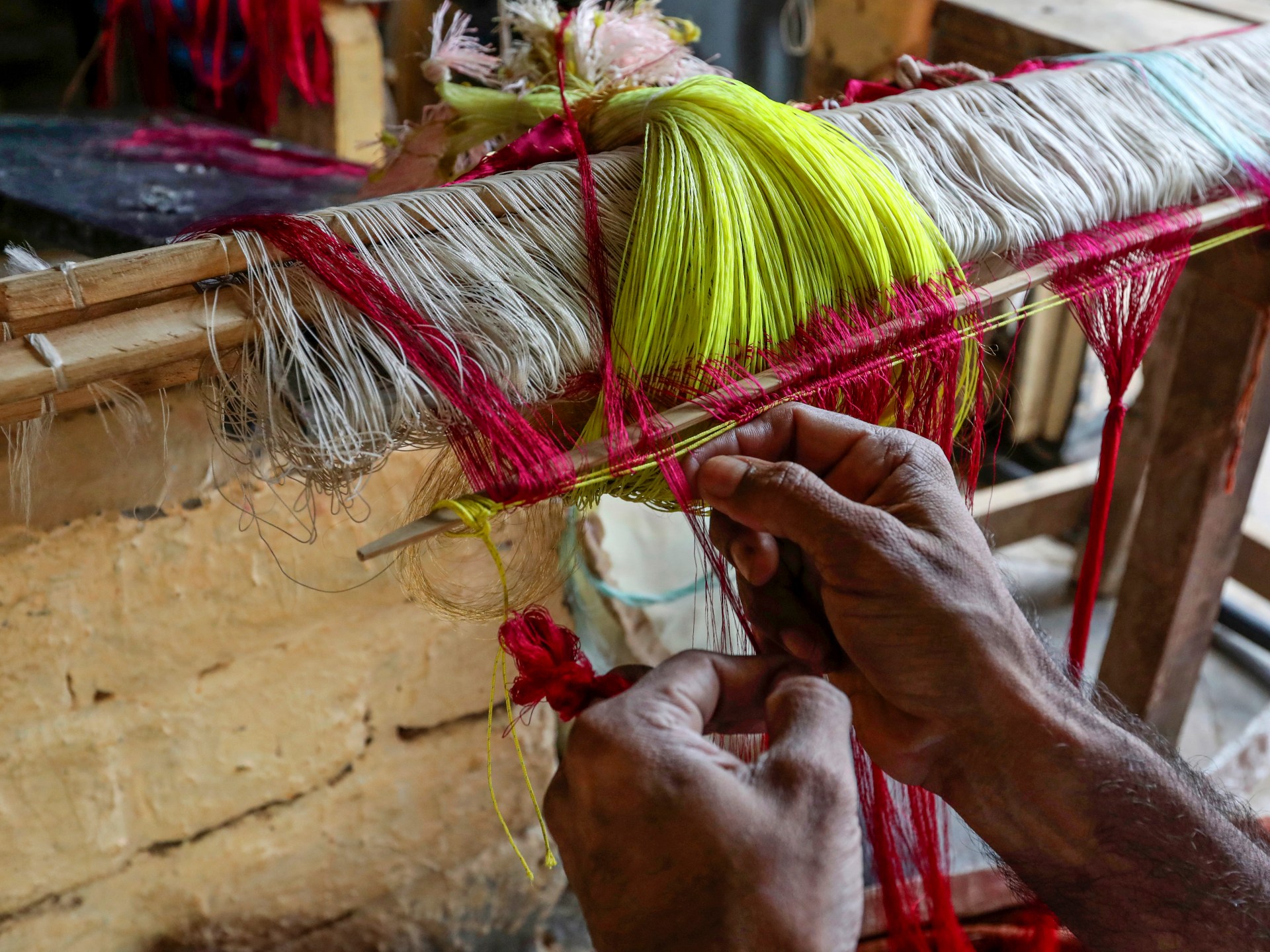
Technological tools meant to preserve a craft are now able to digitally reproduce it without involving the craftsperson. Save Share Bitupan Deka was out shopping for a “gamusa” (traditional scarf) with his mother in India’s northeastern state of Meghalaya when he noticed something unusual. “Every shop selling the scarf had the same handful of patterns repeated over and over,” he told Al Jazeera over the telephone from Shillong, the capital of Meghalaya. “When I asked around, I found that weavers in Sualkuchi [district in neighbouring Assam state] are paid a one-time fee of roughly 2,000 rupees [$21] for each design they develop, instead of royalties. Cutting down the number of designs they produce was a cost-saving practice followed by the manufacturers.” This discovery prompted Deka, an assistant professor of computer technology at Shillong’s MIT University, to create a system that can produce infinite new designs for such fabrics. “My work isn’t meant to replace the traditional designers. I hope, instead, that it will become a tool in their hands to create new and modern motifs more easily, so the consumers can have variety,” Deka said. Once the patent, which is being applied for under the research and development department of his university, comes through, Deka plans to monetise the system by making it a commercial designing service that the textile industry can avail. In India’s varied textile traditions, patterns and motifs carry the memory of a place and the mythology of its people – sometimes even the history of migrations. The designs are imagined by weavers from things that exist around them, and then painted with locally available colours, mostly using carved clay and wooden frames. These weavers do not simply reproduce a pattern; they inherit it. Their hands hesitate where their grandmother’s did, and they know why a particular flower must face left. A computer has no such inheritance or hesitation. It learns by analysing pictures and repeating them in endless variations. And yet, as Deka’s system shows, the computer can now draw and weave the same flower. The Rekh Sanganeri Dataset is a similar system developed for hand-block printed Sanganeri textiles from the western Indian state of Rajasthan. It includes high-resolution images of printed patterns, annotated down to ink bleed and slight misalignment – the imperfections that are the hallmark of the handmade work....