Yemen: Maps show 10 years of changing control
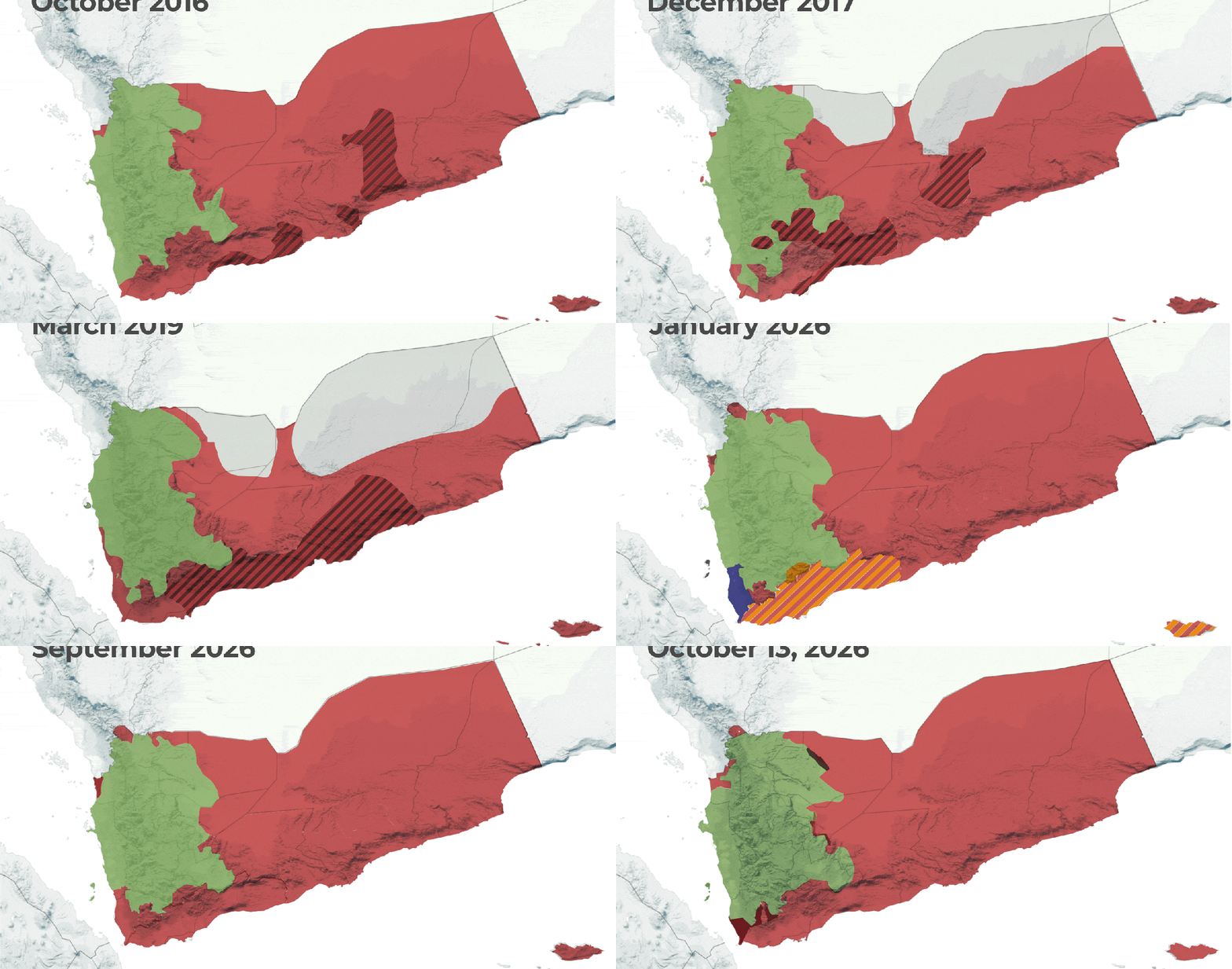
A decade of war has shifted Yemen’s front lines, but the Houthis still hold the capital, Sanaa, and no side controls the country. Save Share Looking at maps of who controls which areas of Yemen over the past 12 years of war reveals changing alliances and coalitions, all while the country faces poverty and malnutrition. TheHouthiarmed group, also known as Ansar Allah (Arabic for Supporters of God), seized the capital, Sanaa, on September 21, 2014, after advancing south from their heartland of Saada in northern Yemen. The Iran-allied group used antigovernment grievances to gain support after July 2014 fuel subsidy cuts triggered anger. The Houthis mobilised protests demanding the reversal of the government’s decisions, and subsequently its resignation. They allied with forces loyal to former President Ali Abdullah Saleh, which helped them capture military positions and state institutions. Then-President Abd-Rabbu Mansour Hadi fled to Aden in February 2015. When forces aligned with the Houthis and Saleh advanced towards the southern port city, Hadi took refuge in the Saudi capital, Riyadh. In March 2015, Saudi Arabia launched a military intervention to restore his internationally recognised government. Over the next decade, alliances broke and front lines shifted. In this visual explainer, AJLabs uses seven maps to track how Yemen has been fragmented, and how no side has been able to control the whole country. By late 2016, two years after the Houthis seized Sanaa, Yemen was split into rival zones of control. The Houthi-Saleh alliance controlled Sanaa and much of the northern and western heartlands, home to most of Yemen’s population. Pro-government forces held territory across the south and the east, supported by Saudi Arabia and the United Arab Emirates. Al-Qaeda in the Arabian Peninsula (AQAP) also challenged government authority across parts of the south. The antigovernment alliance in Yemen went through its most significant fracture after Saleh appeared close to switching sides in the conflict, leading to a short outbreak of fighting with the Houthis, who then killed Yemen’s former longtime president in Sanaa in December 2017. This left the Houthis, a primarily Zaidi Shia group, in sole charge of much of northwestern Yemen, including Sanaa and the port city of Hodeidah. Some pro-Saleh forces switched sides, and pro-government and anti-Houthi forces controlled territory across the south and the east while AQAP retained pockets of influence....